Mostrando las entradas con la etiqueta grammar. Mostrar todas las entradas

miércoles, 12 de octubre de 2016

Present Continuous-Ingles

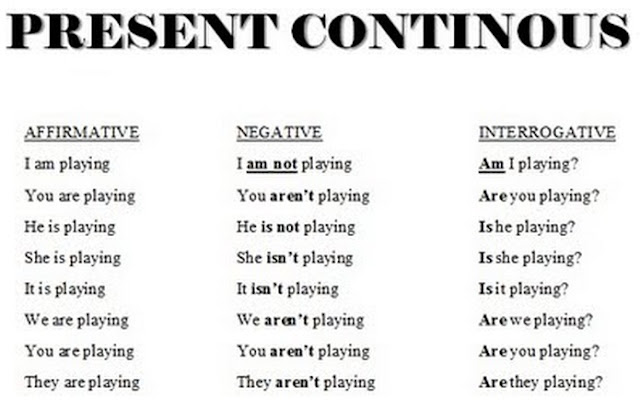
Present Continuous.


El "present continuous" de cualquier verbo se compone de dos partes: el presente del verbo to be + el "present participle" del verbo principal.
(Para formar el "present participle": raíz+ing, e.g. talking, playing, moving, smiling)
Resultado de imagen para Present Continuous

Past Perfect, Present Perfect-Ingles

 Past perfect, Present perfect.

Past Perfect:
The past perfect refers to a time earlier than before now. It is used to make it clear that one event happened before another in the past. It does not matter which event is mentioned first - the tense makes it clear which one happened first.

Resultado de imagen para past perfect

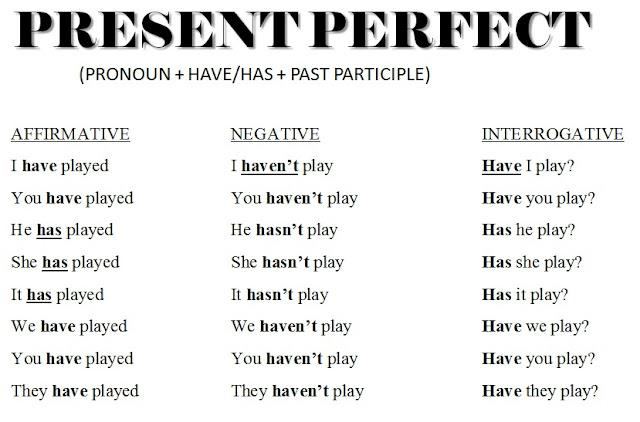
Present Perfect:
The "present perfect" of any verb is composed of two elements: the appropriate form of the auxiliary verb to have (at present) and the "past participle" the main verb. The shape of the "past participle" is a regular verb root + ed, e.g. played, arrived, looked. As for the irregular verbs, see Table of irregular verbs 'verbs' section.

Resultado de imagen para present perfect

martes, 11 de octubre de 2016

Used to/ Would- Inglés

Used To/ Would

Used to
It is usually followed by an infinitive: We used to swim in the river.But sometimes the following infinitive is left out: ♦ I don’t play golf now, but I used to.
Used to only exists as a past tense.
Questions and negatives are usually formed with ‘did’ + use to (with no ‘d’): Did you use to work here? ♦ We didn’t use to earn much. The spelling ‘did used to’ is sometimes used, but many people think that this is wrong.
In formal English, negatives are often formed with used not toThey used not to allow shops to be open on Sundays. The short forms usen’t to and usedn’t to are sometimes used, but they sound rather formal and old-fashioned.

Would

we use it for repeated actions or routines in the past. We do not use Would with stative verbs, because they describe states and not actions. 

Example: We used to/would go camping by the river. (we don´t go camping anymore).

Using "would" in place of "used to" when talking about actions done multiple times in the past is exceedingly common in everyday speech.

Resultado de imagen para would and used to


miércoles, 21 de octubre de 2015

TEST GRAMMAR-Inglés

Hi!!!


UNIT 36

     Verbs with three parts:

  • catch up with
  • cut down on
  • drop in on
  • get along/on with
  • keep up with 
  • live up to
  • look forward to
  • look out onto/over
  • put up with
  • run out of

     Verbs with two parts:

  • call for
  • call on
  • deal with
  • get at
  • get over
  • head for 
  • join in
  • see to
  • stand for
  • take after

UNIT 37

   transitive and separable
  • bring up
  • call off
  • clear up
  • cut off
  • fill in
  • give up 
  • knock out 
  • let down
  • look up
  • pick up
  • put off
  • put  up
  • take up 
  • try on
  • turn on/off
  • wash up
   intransitive
  • break down 
  • drop out
  • get on 
  • get away
  • grow up
  • set off/out
  • take off
  • turn up

miércoles, 14 de octubre de 2015

TEST STUDENTS´BOOK-Inglés

UNIT 13

VOCABULARY


  • PART-TIME
  • FULL-TIME
  • TEMPORARY JOBS
  • SELF-EMPLOYED
  • SALARY
  • WAGES
  • ON COMMISSION
  • SET BY
GRAMMAR: Reported questions
                   Have,do or be and modal questions: ONE TENSE BACK
                               
                                         IF/WHETHER : Do you want some more tea? asked Peter.
                                                                   Peter asked if/whether I wanted some mote tea.
                   
                    Wh-questions: ONE TENSE BACK
                                                                               What do you want for dinner? asked my mother
                                                                    My mother asked what I wanted for dinner.
VOCABULARY

  • apply for a job
  • make someone do sth.
  • cause someone to do sth.
  • approve of (doing) sth.
  • complain about sth.
  • be interested in (doing) sth-
  • be made to do sth.
  • be involved in (doing) sth.
  • apologise for ( doing) sth.
  • insist on (doing) sth.
GRAMMAR: Indirect questions

    1 Question marks

                The ones starting with a modal or an auxiliary : WITH QUESTION MARK
               The ones starting with"I wonder if you..." I would like to know...": NO QUESTION MARK


   2 Word order

                Do not use the question form.


   3 Have, or  be and modals questions; and Wh- questions:

                The same as in reported questions


    4 Tense changes
               
                 Do not change the tense.